

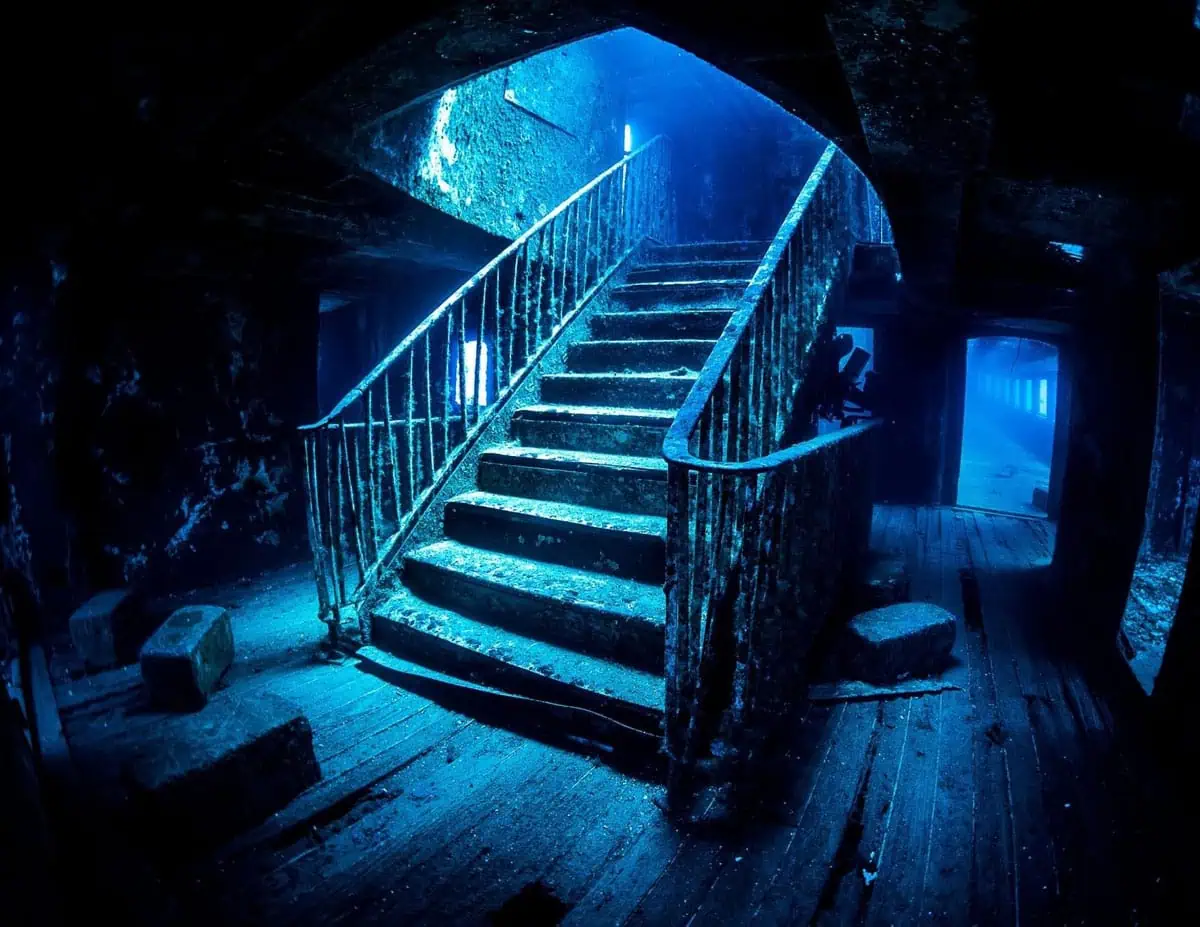
Diving the MV Karwela Wreck, Gozo: The Ferry with the Famous Staircase
Ask any diver who has spent time in the Maltese Islands to name one wreck worth crossing the channel for, and the answer is usually the same: the MV Karwela. Sitting perfectly upright on clean white sand off Xatt l-Aħmar on Gozo’s south-eastern coast, this 50-metre former passenger ferry has become the most dived wreck in Gozo — and home to one of the most photographed underwater staircases in the Mediterranean.
At Watercolours Dive Centre, the Karwela is a firm favourite with our guides and our guests alike. Here is everything you need to know before you drop down onto her decks.
MV Karwela at a Glance
Location | Xatt l-Aħmar, south-east Gozo (near Mġarr Harbour) |
Type | Wreck dive — scuttled passenger ferry, artificial reef |
Depth | Top deck from ~30 m · bow at 39 m · stern at 41 m |
Length | Approx. 50 m, 497 gross tons |
Access | Shore entry (most common) or boat |
Level | Advanced/deep-certified divers (40 m); wreck speciality for penetration |
Highlights | The famous double staircase, three explorable decks, engine room, neighbouring wrecks |
Best gas | Nitrox strongly recommended for longer bottom time |
A Ferry with Three Lives: The History of the Karwela
The Karwela’s story begins far from the Mediterranean. She was built in 1957 at the Jos. L. Meyer shipyard in Papenburg, Germany, and spent her early career as the Frisia II, a North Sea passenger ferry. Renamed Nordpaloma in 1981, she eventually made her way to Malta in the mid-1980s, where Captain Morgan Cruises put her to work carrying tourists around Valletta’s Grand Harbour.
Her third life began on 12 August 2006, when the Gozo Tourism Association scuttled her — together with her fleet-mate the MV Cominoland — as an artificial reef and dedicated dive attraction. The preparation was meticulous: the vessel was environmentally cleaned, hazardous materials were removed, large openings were cut into the hull and decks for safe access, and buoyancy tanks were used during the sinking to make sure she settled upright on the seabed. She did — perfectly.
A quirky footnote: shortly after the scuttling, local divers floated a Volkswagen Beetle out to the site and sank it onto her stern deck. Little of the car survives today, but it remains part of Karwela folklore.
The Dive: What to Expect on the Karwela
The Karwela is most often dived from shore at Xatt l-Aħmar. After a giant stride entry, you swim out over the reef plateau and drop over the edge — and in Gozo’s famously clear water, the silhouette of the wreck often appears out of the blue while you are still well above her. On good days she is visible almost from the surface.
The bow sits roughly 80 metres from the entry point and about 40 metres from the drop-off, resting at 39 m, with the stern slightly deeper at 41 m. Most divers start with a pass along the hull to take in the full shape of the ship — because she landed bolt upright, the Karwela still looks unmistakably like a ferry rather than a pile of steel — before ascending to the superstructure and the top deck at around 30 m, where the captain’s cabin sits.
The Staircase
Amidships lies the reason the Karwela graces so many magazine covers: an elegant staircase sweeping down from the upper deck to the deck below, lit by rows of portholes. Framed by ambient light, a diver descending those steps is arguably the classic Gozo wreck photograph — many divers travel here for that single shot. A second staircase behind the first leads deeper into the vessel, opposite the engine room, where a torch is essential.
Penetration and Deck Layout
With three decks to explore and generous openings cut along both sides of the first two, the Karwela is one of the most rewarding — and forgiving — penetration wrecks in the Maltese Islands. Wide passageways, removed doors and windows, and plenty of natural light make swim-throughs enjoyable rather than intimidating. That said, this is still an overhead environment at depth: proper wreck training, a good torch and disciplined gas planning are non-negotiable.
The Return
Heading home, the reef wall provides a natural visual reference for a gradual ascent, and the shallow plateau makes a perfect, unhurried safety stop. Keep your eyes on the reef — octopus, moray eels and the occasional seahorse turn the end of the dive into a bonus in its own right.
Marine Life on the Wreck
Two decades underwater have transformed the Karwela into a thriving artificial reef. The superstructure is steadily colonising with encrusting growth, tube worms and sponges, while the wreck and surrounding sand attract moray eels, grouper, scorpionfish, white sea bream (sargu) and shoals of damselfish. Barracuda patrol the blue above the decks, and the neighbouring reef adds octopus and nudibranchs to the tally. Photographers get the best of both worlds: big structure and small critters on a single tank.
Who Can Dive the MV Karwela?
- Depth certification: with the decks lying between 30 and 41 m, you’ll need a deep diving certification (40 m) and genuine comfort at depth. This is not a site for newly qualified Open Water divers.
- Wreck penetration: entering the wreck calls for a wreck diver speciality (or equivalent experience) and a primary torch.
- Nitrox: enriched air makes a real difference here, meaningfully extending no-decompression time on the decks. If you’re not yet nitrox certified, the course can be completed alongside your diving.
- Technical divers: the Karwela is also a superb decompression and training platform, with stable depth, easy navigation and excellent visibility.
Not there yet? Watercolours Dive Centre can take you through the Deep, Wreck and Nitrox specialities right here in Malta and Gozo — with the Karwela herself as the graduation dive.
One Bay, Four Wrecks
Part of the Karwela’s appeal is her neighbourhood. She is the middle vessel of the famous Xatt l-Aħmar wrecks, with the MV Cominoland about 60 metres to the east and the upturned MV Xlendi roughly 60 metres to the west. A fourth wreck, the tanker MT Hephaestus, was scuttled nearby in 2022. Few places in Europe let you dive multiple purpose-sunk wrecks from a single shore entry — which is exactly why Xatt l-Aħmar features on so many divers’ Gozo itineraries, often as a two-dive day: Karwela first, Cominoland after the surface interval.
When to Dive & Conditions
The site is diveable for most of the year. Visibility regularly exceeds 30 metres, at its best in spring and autumn, and the bay is well protected from the prevailing north-westerlies — though strong southerly winds can make entry uncomfortable. Water temperatures range from around 15°C in late winter to 26–27°C in late summer, so a 5–7 mm wetsuit or a drysuit is recommended outside the summer months.
Dive the Karwela with Watercolours Dive Centre
From our base in Malta, we run regular guided trips to Gozo’s wrecks, including the MV Karwela — handling logistics, tanks, nitrox fills and expert local guiding so all you have to do is enjoy the dive. Whether you’re chasing that staircase photograph, building deep and wreck experience, or planning a technical training dive, our team knows this wreck inside out. Literally.
Ready to descend the most famous staircase in the Mediterranean? Get in touch with Watercolours Dive Centre to book your MV Karwela wreck dive.
MV Karwela FAQs
How deep is the MV Karwela wreck?
The wreck sits upright on sand with her bow at 39 m and stern at 41 m. The top deck and captain’s cabin start at around 30 m.
Can beginners dive the Karwela?
No — the depth requires a deep diving certification (40 m) and solid experience. Advanced divers can enjoy the upper structure within recreational limits; wreck-certified divers can penetrate the decks.
Is the Karwela a shore dive or a boat dive?
Both are possible, but it is most commonly dived from shore at Xatt l-Aħmar, a short swim from the entry point.
Why is the Karwela staircase famous?
The porthole-lit staircase amidships is one of the most photogenic wreck interiors in the Mediterranean and has featured in countless dive magazines — many divers visit specifically for that photo.
What marine life will I see?
Moray eels, grouper, scorpionfish, sea bream, barracuda and octopus are common, with rich encrusting life across the superstructure and occasional seahorses on the nearby reef.


