

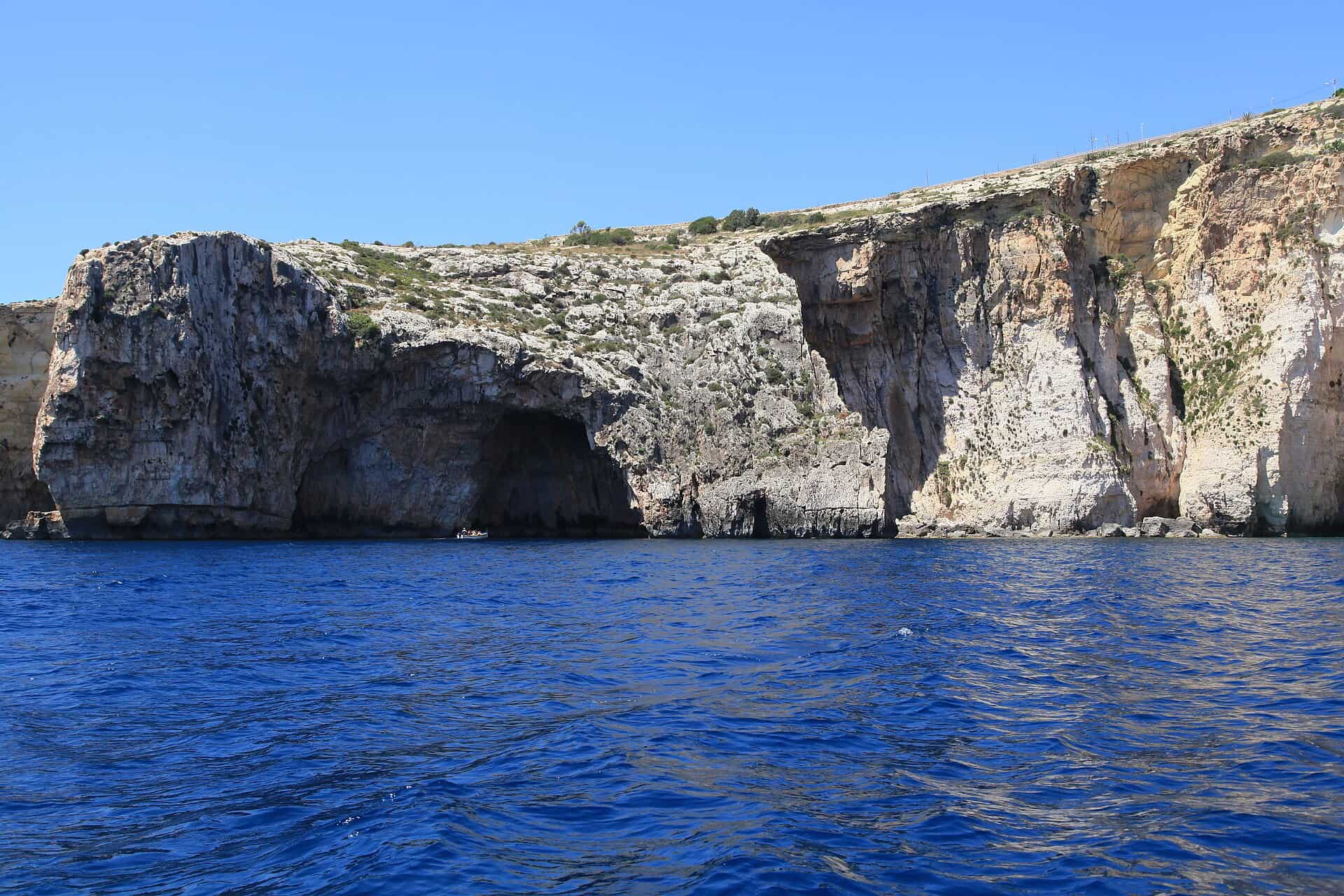
Diving at Wied iz-Zurrieq. Photo by Frank Vincentz – Own work
Diving at Wied iż-Żurrieq: Malta's Gateway to the Um El Faroud
A narrow inlet on Malta’s rugged south coast, just minutes from the famous Blue Grotto, is the entry point to one of the Mediterranean’s most celebrated wreck dives – the Um El Faroud – as well as a beautiful stretch of reef, caverns and drop-offs that reward divers of every level.
In this guide, the team at Watercolours Dive Centre covers everything you need to know about diving Wied iż-Żurrieq: the sites, the depths, the marine life, and how to make the most of a day on Malta’s south coast.
Where Is Wied iż-Żurrieq?
Wied iż-Żurrieq (“the valley of Żurrieq”) is a steep-sided inlet on the southern coast of Malta, near the village of Żurrieq and the Blue Grotto sea caves. The valley funnels down to a small slipway and quay used by the colourful Blue Grotto tour boats — and by divers, who giant-stride or walk in from the same sheltered entry point.
The inlet itself is shallow and protected, making it an easy, controlled entry and exit. Once you swim out past the mouth of the inlet, the seabed opens onto a dramatic underwater landscape of boulders, walls and reef plateaus, with the Um El Faroud resting on the sand a short swim to the west.
The Um El Faroud: Malta’s Favourite Wreck Dive
A ship with a story
The Um El Faroud was a Libyan-owned motor tanker of around 10,000 tonnes and roughly 110 metres in length. In 1995, while in dry dock in Malta, a gas explosion on board tragically killed nine dockyard workers — a loss still commemorated by a memorial plaque on the wreck. Deemed beyond economical repair, the vessel was cleaned and scuttled off Wied iż-Żurrieq in September 1998 as an artificial reef and diving attraction.
Winter storms later cracked the hull, and the wreck now lies in two sections on the sand — which, if anything, has made her even more interesting to explore.
The dive
The Um El Faroud sits upright on a sandy bottom at a maximum depth of around 36 metres, with the main deck at roughly 25 metres and the top of the superstructure shallower still. Her sheer scale is what stays with most divers: swimming along the towering hull, hovering over the bridge, and dropping past the enormous propeller at the stern is an unforgettable experience.
This is a dive best suited to advanced or deep-certified divers due to the depth and the swim from shore. Suitably trained and experienced divers can explore parts of the interior with a guide, while nitrox is a popular choice for extending bottom time at deck level.
Reefs, Caverns and Walls: More Than Just a Wreck
The wreck may be the headline act, but Wied iż-Żurrieq would be a superb dive site even without it. Highlights include:
- The inlet and reef plateau — an easy, scenic dive from 5 to 18 metres, ideal for training dives, check dives and underwater photography.
- Caverns and swim-throughs — the coastline either side of the inlet is riddled with caves and archways filled with shimmering blue light, including the well-known Bell Tower Cave area towards the Blue Grotto.
- Walls and drop-offs — outside the inlet, the reef falls away in steps and mini-walls, perfect for multi-level dives and drift-style exploring when conditions allow.
Marine Life at Wied iż-Żurrieq
The south coast’s clear, blue water — visibility of 20 to 30 metres is common — makes marine life easy to spot. Around the reef you’ll find shoals of damselfish and sea bream, scorpionfish, octopus, moray eels, colourful nudibranchs and, in the shallows, flitting rainbow wrasse. The wreck itself acts as a magnet for life: barracuda often patrol above the superstructure, while groupers, amberjack and the occasional passing tuna add a sense of drama to the deeper sections.
Depths, Conditions and Who Can Dive Here
- Depth range: 5–18 m on the inner reef; 30–36 m on the Um El Faroud.
- Entry: shore entry from the slipway in the inlet; keep to the sides and watch for Blue Grotto boat traffic on the surface.
- Conditions: excellent in calm weather; the site is exposed to southerly winds and swell, so your dive centre will always check conditions first.
- Level: the inlet and reef suit newly certified divers; the wreck is for advanced/deep divers, ideally on nitrox.
- Don’t miss: the propeller at the stern, the bridge, and the memorial plaque honouring the nine dockyard workers.
Dive Wied iż-Żurrieq with Watercolours Dive Centre
As one of Malta’s leading dive centres, Watercolours Dive Centre runs guided dives to Wied iż-Żurrieq and the Um El Faroud throughout the season. Our experienced local guides know the site inside out — from the best route around the wreck to the hidden caverns most visitors swim straight past — and we handle transport, tanks, weights and site logistics so you can focus on the diving.
Whether you’re an advanced diver dreaming of the Um El Faroud or a newer diver ready to explore Malta’s south coast reefs, get in touch with Watercolours Dive Centre to book your Wied iż-Żurrieq dive today.
Frequently Asked Questions
How deep is the Um El Faroud wreck?
The wreck rests on sand at a maximum depth of around 36 metres, with the main deck at approximately 25 metres, making it a dive for advanced or deep-certified divers.
Can beginners dive at Wied iż-Żurrieq?
Yes. While the Um El Faroud requires an advanced certification, the sheltered inlet and surrounding reef offer excellent diving between 5 and 18 metres that’s well suited to newly certified divers and training dives.
Is Wied iż-Żurrieq a shore dive or a boat dive?
Wied iż-Żurrieq is dived from shore, with an easy entry and exit via the slipway in the inlet. The Um El Faroud is reached with a surface or underwater swim from the same entry point.
When is the best time to dive Wied iż-Żurrieq?
Malta offers year-round diving, and Wied iż-Żurrieq is at its best in calm conditions with light northerly winds. Water temperatures range from around 15°C in winter to 26°C or more in late summer.
What will I see on the Um El Faroud?
Expect a hugely atmospheric wreck — bridge, funnel, holds and a massive propeller — patrolled by barracuda, groupers and shoals of reef fish, with visibility often exceeding 25 metres.


